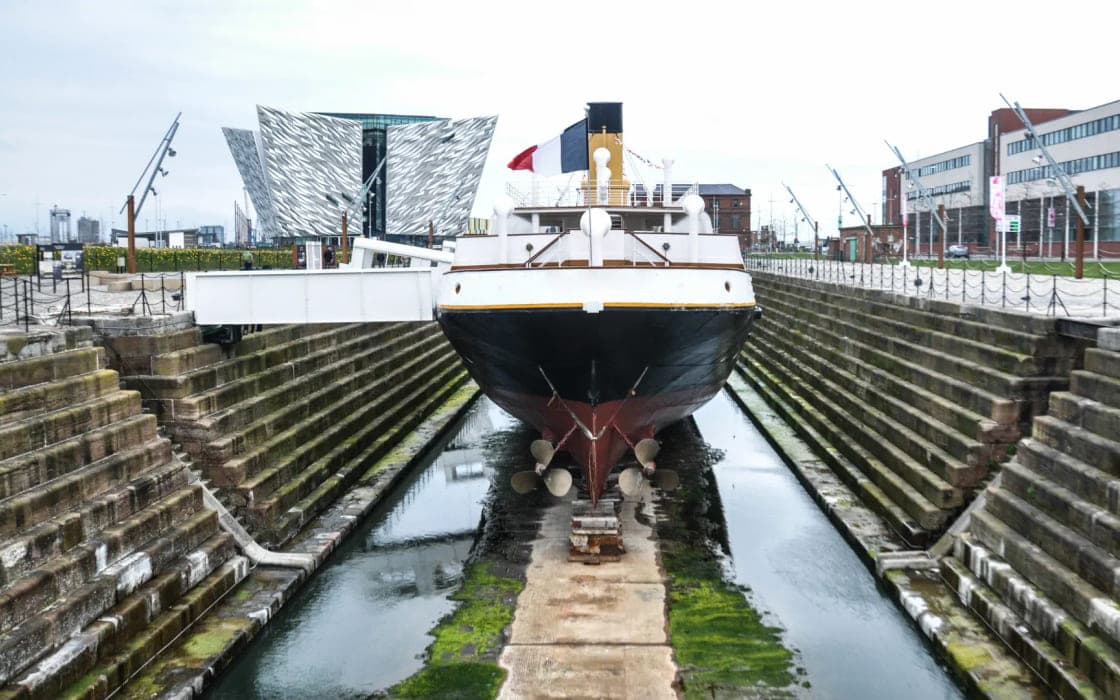
Titanic Belfast stands on the exact spot where the ship was designed, built and launched — the Harland & Wolff slipways in the Queen's Island yard. That matters more than you would expect. The building's four angular hulls are the height of the original ship's bow, and the slipway outside is marked out to full scale. You walk the length of it.
Getting there from Dublin
Belfast is 165 kilometres from Dublin, about two hours on the M1 and A1. There is no border check, no passport control, and no formality of any kind — but Northern Ireland uses pounds sterling rather than euro. Cards are accepted everywhere; there is no need to change money.
The museum itself
Nine galleries, roughly two hours if you read things, ninety minutes if you do not. It covers Belfast's industrial boom, the design and construction, the fit-out, the launch, the maiden voyage, the sinking, the inquiries, and the wreck's rediscovery in 1985. There is a ride section through a reconstruction of the shipyard, and a full-height projection of the wreck footage at the end.
Book a timed slot online. Weekends and school holidays sell out.
SS Nomadic, the Titanic's original tender and the last surviving White Star Line vessel afloat, sits in a dry dock beside the building and is included in the ticket. Most people miss it. Do not.
Combining it with the north coast
Belfast and the Giant's Causeway in one day from Dublin is possible but hard — it is a thirteen-hour day with about seven hours of driving. If you have to choose, choose based on what you want: the Causeway and the Antrim Coast Road are the better landscape day; Titanic Belfast is the better museum.
If you do both, the sensible order is Causeway first thing, Antrim Coast Road south during the afternoon, Belfast in the late afternoon, and back down the M1 in the dark. We run this route as a private day tour and will tell you honestly on the day whether both will fit.
Also in Belfast
- The black-taxi murals tour — the Falls and Shankill Roads, with a driver who lived through it. An hour and a half, and the most affecting thing in the city.
- Crumlin Road Gaol — a Victorian prison, in use until 1996.
- The Cathedral Quarter — for eating and drinking afterwards.